


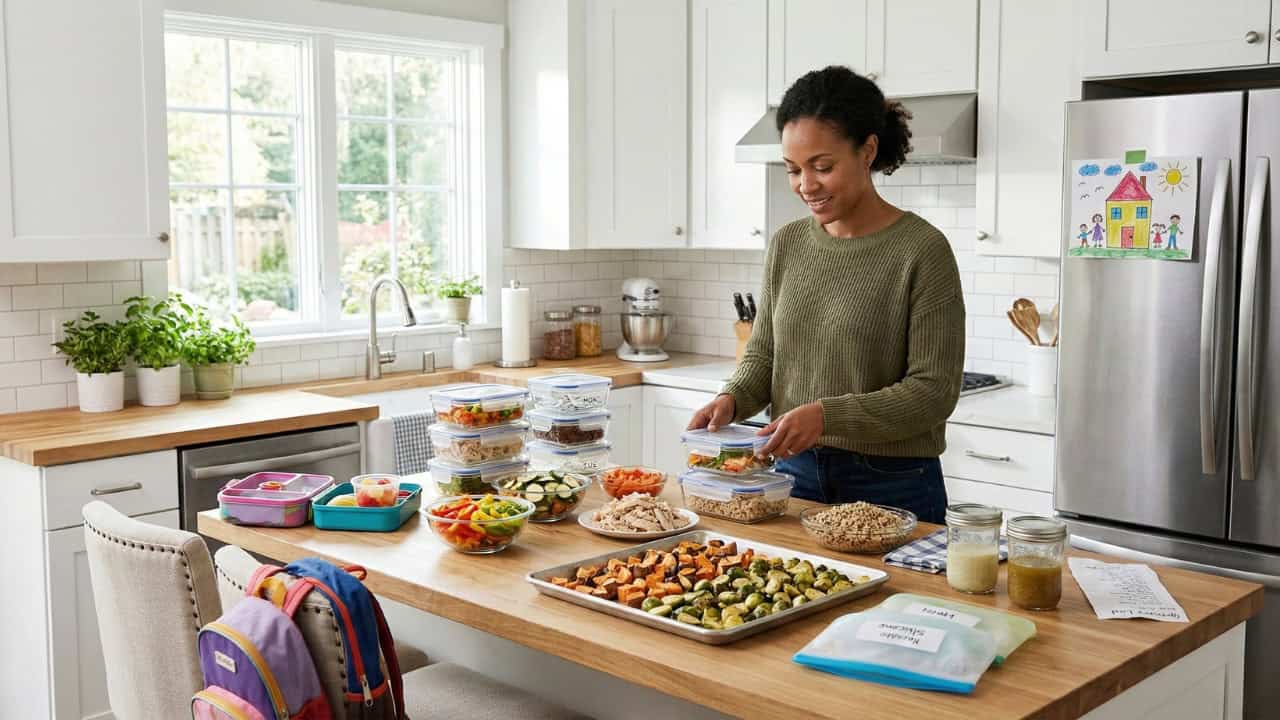
Why Meal Prep Is a Mom’s Most Powerful Weekly Tool
The average family makes hundreds of food decisions every week: what to buy, what to cook, when to cook it, how to handle the evening when two kids have activities and dinner needs to appear in 20 minutes. Decision fatigue around food is real, and it is one of the primary drivers of expensive takeout orders and the mid-week ‘cereal for dinner’ situation that most parents know well.
Family meal prep, done even partially, changes the calculus. When Tuesday’s dinner is already half-prepared because the chicken was cooked on Sunday and the vegetables are roasted and waiting, the 6 PM weeknight scramble becomes something a tired parent can actually navigate. This guide walks through exactly how to build that system: what to prep, how to prep it, how to stretch a tight grocery budget, and how to handle the picky eaters that make family food feel complicated.
How to Plan a Family Meal Prep Session
The Planning Steps
- Audit your fridge and pantry before you shop. What proteins, grains, and produce do you already have? What can be used this week to minimize waste?
- Check the week’s schedule. Which nights are the most chaotic? Those nights need the most fully-prepared meals. Which nights have time to cook fresh? Those nights need only partially prepped components.
- Choose 4-5 base proteins and 3-4 versatile sides. Everything else is a combination of these. You are not meal prepping individual recipes. You are prepping components.
- Write the shopping list by category. Produce, proteins, dairy, pantry, frozen. This structured list reduces impulse purchases and ensures nothing is missed.
- Block 2-3 hours on Sunday. This is your investment window. Two to three hours on Sunday returns 30-45 minutes saved on every weeknight.
The Best Foods to Batch Cook for Families
Proteins
- Shredded chicken (slow cooker or oven-baked chicken breasts or thighs, then shredded): Goes into tacos, quesadillas, soups, grain bowls, pasta, and sandwiches.
- Ground beef or turkey (browned with onion and garlic): Becomes spaghetti sauce, taco meat, stuffed peppers, or fried rice addition.
- Hard-boiled eggs (one dozen): Quick breakfasts, snacks, egg salad, toppings for salads and ramen.
- Baked salmon or white fish (can be flaked into many applications): Grain bowls, tacos, pasta, or eaten simply with vegetables.
- Beans (dried or canned, cooked): Black beans, chickpeas, and lentils add protein and fiber to nearly any meal at minimal cost.
Grains and Bases
- White or brown rice (large batch): The most versatile base for nearly any cuisine direction.
- Quinoa (high protein, faster cooking than rice): Works in grain bowls, cold salads, as a porridge base.
- Pasta (partially cooked, dressed lightly with olive oil to prevent sticking): Ready to finish in sauce within minutes.
- Overnight oats (mason jars prepped for Monday-Wednesday breakfasts): Refrigerator-ready, customizable per child.
Vegetables
- Sheet pan roasted vegetables (broccoli, zucchini, bell pepper, sweet potato, onion): Roast two full sheet pans. Reheat in anything, eat cold in bowls, or blend into sauces.
- Steamed broccoli and green beans: Fastest preparation, widely accepted by children.
- Washed and chopped raw vegetables (carrots, celery, cucumber, cherry tomatoes): Ready for snacks and salads without any prep time mid-week.
- Chopped onion and garlic: Prep a full bag of each. Eliminates the most time-consuming knife work of nearly every weeknight recipe.
Full Weekly Family Meal Plan
| Day | Dinner | Prepped Ahead |
| Monday | Shredded chicken tacos with rice, guac, and shredded cheese | Shredded chicken, rice, chopped toppings |
| Tuesday | Sheet pan chicken thighs with roasted sweet potato and broccoli | Mostly fresh (15 min prep), vegetables pre-chopped |
| Wednesday | Ground turkey spaghetti with hidden-veggie tomato sauce and garlic bread | Sauce pre-made, pasta pre-cooked, garlic pre-minced |
| Thursday | Chicken and rice bowls with roasted veg, avocado, and lemon tahini | Chicken, rice, and vegetables all reheated from Sunday |
| Friday | Homemade pizza (naan or flatbread base) with family toppings night | Toppings pre-cut Sunday, kids build their own |
| Saturday | Slow cooker beef stew with crusty bread | Dump in ingredients Friday night, cook Saturday |
| Sunday | Simple roast chicken with sheet pan vegetables | Start fresh, prep ahead for next week during cooking |
How Long Meal-Prepped Food Lasts: Storage Guide
| Food Item | Refrigerator (days) | Freezer (months) |
| Cooked chicken (shredded or whole) | 3-4 days | 3-4 months |
| Cooked ground beef or turkey | 3-4 days | 3-4 months |
| Cooked rice or quinoa | 4-6 days | 1-2 months |
| Cooked pasta | 3-5 days | 1-2 months |
| Roasted vegetables | 4-5 days | 2-3 months |
| Hard-boiled eggs (unpeeled) | 7 days | Not recommended |
| Soups and stews | 3-4 days | 4-6 months |
| Cooked beans | 5-7 days | 3-4 months |
Budget-Friendly Meal Prep Tips
Family meal prep on a tight budget begins at the planning stage: buying what is on sale and building the week’s meals around sale proteins rather than deciding what you want to eat and then paying whatever it costs is the single highest-impact budget move available.
- Buy proteins in bulk and portion for freezing. A large package of chicken thighs or ground beef is always less expensive per pound than smaller packages. Divide into meal-sized portions, label with the date, and freeze what you will not use within three days.
- Use frozen vegetables strategically. Frozen broccoli, peas, spinach, edamame, and mixed vegetables have identical or superior nutritional profiles to fresh (they are frozen at peak ripeness) and cost significantly less. They are also already prepped, which reduces prep time.
- Make beans the hero, not the side. A pound of dried black beans costs under two dollars and provides protein for multiple family meals. Chili, bean and rice bowls, bean quesadillas, and bean soups are among the most nutritionally complete and cost-effective family meals.
- Repurpose intelligently. Leftover roast chicken becomes chicken soup. Leftover rice becomes fried rice. Leftover roasted vegetables become a frittata. Designing meals that flow into each other eliminates waste and stretches the grocery budget over more meals.
Meal Prep for Picky Kids: The Components Approach
The greatest meal prep frustration for parents of picky eaters is prepping a specific dish and having a child refuse it. The solution is prepping components, not dishes. When a child can build their own plate from a selection of individually prepared components, the likelihood of eating something increases dramatically because the child has autonomy over the combination.
A deconstructed taco bowl is the canonical example: rice in one container, beans in another, shredded chicken in another, shredded cheese, sour cream, and salsa available separately. The adventurous child builds a loaded bowl. The cautious child eats rice with cheese and a piece of chicken. Everyone eats from the same prep without the parent making multiple meals.
For toddlers, finger food prep is the relevant application: cheese cubes, carrot rounds, cooked pasta in small shapes, steamed broccoli florets, berry halves, and small pieces of protein prepped on Sunday and available throughout the week require zero preparation at mealtime.
Essential Meal Prep Equipment
- Glass storage containers with locking lids (8-10 pieces in 2-3 sizes): Glass heats evenly, does not absorb food odors, and does not leach chemicals into food when heated.
- Two large sheet pans: The most frequently used tool in any meal prep session.
- A slow cooker or Instant Pot: Dump-and-forget cooking is the highest-ROI cooking method for busy families.
- A sharp chef’s knife and cutting board: The prep time savings from a good knife are significant.
- Mason jars in various sizes: For overnight oats, sauces, salad dressings, and portioned snacks.
Frequently Asked Questions
How do I start meal prepping for a family?
Start with just one or two components rather than full meals. Cook a large batch of protein (shredded chicken or ground beef) and a large batch of rice or quinoa on Sunday. That single preparation gives you a base for at least three to four dinners with minimal additional work. Add one more component each week until you have a full system.
Is meal prep actually worth the time?
For most families, yes. The average meal prep session of 2-3 hours on Sunday saves approximately 30-45 minutes per weeknight. Across a week, that is 2.5-3.75 hours saved in evening cooking time. Additionally, families with meal prep systems consume significantly fewer takeout meals, which reduces food costs considerably.
How long does meal prep last in the fridge?
Most cooked proteins last 3-4 days in the refrigerator. Cooked grains last 4-6 days. Roasted vegetables last 4-5 days. Soups and stews last 3-4 days. Anything approaching 4+ days should be checked carefully before serving. Prep in quantities that will realistically be used within the safe storage window.
What are the easiest meal prep ideas for families with picky eaters?
The components approach is the most effective strategy: prep proteins, grains, and vegetables separately so each family member can build their own plate. Shredded chicken, rice, roasted broccoli, and shredded cheese as separate containers is one Sunday prep session that creates four different ‘meals’ depending on how each person combines them.
What containers are best for family meal prep?
Glass containers with locking lids are the most durable and food-safe option for meal prep storage. They heat evenly in the microwave, do not absorb odors, and last for years. For bulk grain and dry storage, wide-mouth Mason jars are cost-effective and practical. Avoid heating food in thin plastic containers.
| QUICK ANSWER
Family meal prep works best when you batch cook 3-4 versatile proteins, 2-3 base grains, and a variety of roasted or steamed vegetables on Sunday, then combine them into different meals throughout the week. The biggest time and money savers are: roasting a full tray of chicken thighs, cooking a large pot of rice or quinoa, and preparing a batch of a sauce or base (tomato, pesto, stir-fry) that can transform the same proteins into entirely different dinners across the week. |