


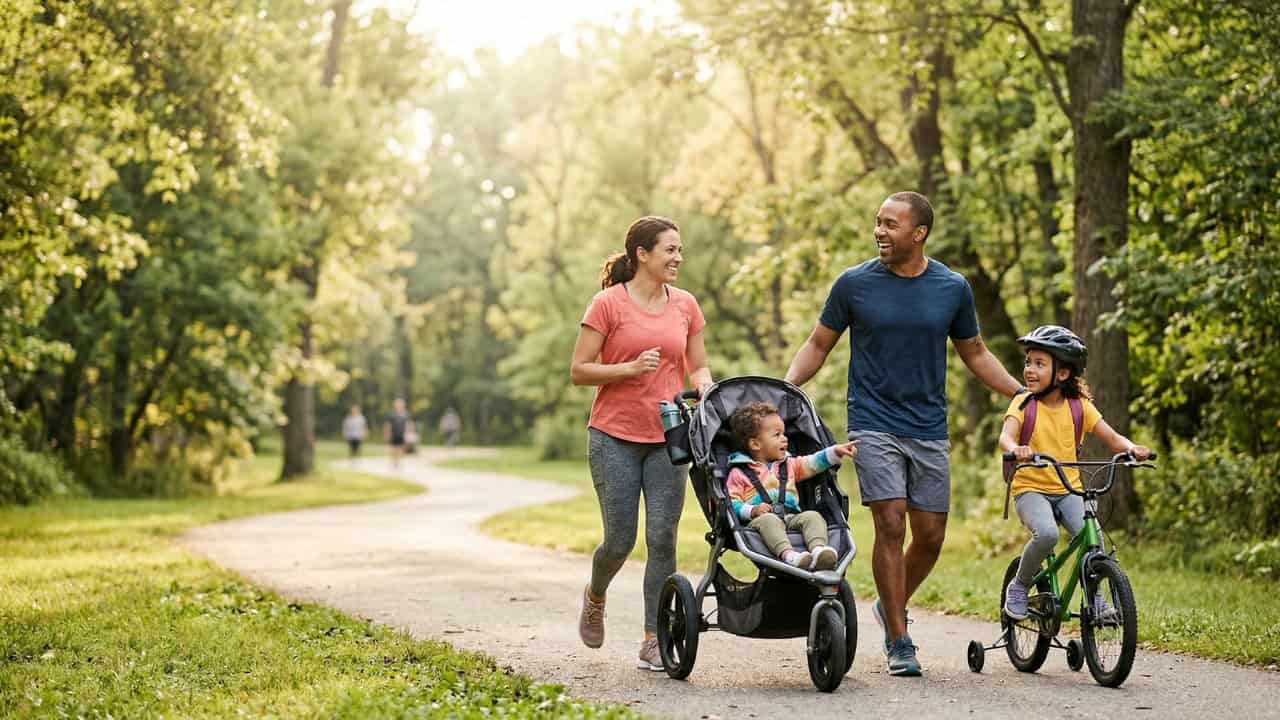
Why Family Fitness Is About More Than Weight
Before building a family fitness routine, it is worth being clear about what you are actually building toward. Weight management is one outcome of regular physical activity, but it is a poor primary motivator for a routine involving children. Children internalize the meaning adults assign to exercise. A family culture where movement is for fun, for strength, for adventure, and for togetherness produces children who are more likely to be active as teenagers and adults than a family culture where exercise is explicitly tied to body size or weight.
The research on family physical activity is compelling across multiple outcome categories: children who are physically active with their parents demonstrate better academic performance, lower rates of anxiety and depression, stronger social relationships, and greater resilience under stress. These benefits exist independently of weight outcomes and are a far more sustainable motivation for building consistent habits.
This guide is built on that premise: movement is for living well, and a family that moves together consistently is building something that goes far beyond fitness.
What the Research Says About Children and Activity
The CDC and American Academy of Pediatrics recommend that children ages 6-17 receive at least 60 minutes of moderate-to-vigorous physical activity daily. Most American children are not meeting this standard. Studies on family-based physical activity interventions consistently show that parental modeling is the strongest predictor of a child’s activity levels, more so than organized sports, school PE programs, or community facilities.
The implication is significant: when you are active with your children, you are not just exercising together. You are shaping the neural and behavioral patterns around movement that will persist into their adolescence and adult lives.
Assessing Your Family’s Starting Point
Before designing a routine, a realistic audit of where you are starting matters. Consider:
- How many days per week does each family member currently engage in sustained physical activity?
- What physical activities do the children genuinely enjoy? What do they ask to do?
- What does your weekly schedule actually look like? Where are the natural windows for movement?
- What equipment, spaces, and community resources do you have available?
- What are the individual fitness levels and physical limitations in the family?
This is not about judgment. It is about designing a system that matches your actual life rather than an idealized version of it. A family starting from near zero and building to three active days per week has made a profound change. The goal is not perfection. It is direction.
Family Fitness Activities by Age Group
Toddlers and Preschoolers (Ages 1-4)
At this age, there is no meaningful distinction between play and exercise. Every form of physical play is exercise, and the most effective thing a parent can do is facilitate a rich physical play environment and participate in it.
| Activity | Why It Works | How Often |
| Dancing to music in the living room | Cardio, coordination, joy, and bonding. No equipment. | Daily |
| Playground visits with active parent participation | Climbing, running, social play. Get on the equipment. | 3-4x weekly |
| Nature walks (short distances, let them explore) | Sensory stimulation, curiosity, gentle endurance. | 2-3x weekly |
| Swimming (parent-assisted) | Full-body development, water confidence. No impact. | 1-2x weekly if accessible |
| Obstacle courses at home (pillows, cushions) | Gross motor skills, creativity, parent-child play. | As desired |
Elementary Ages (5-10)
Children in this age range can participate in structured activity and are ready to begin understanding physical challenge and improvement. The goal is building a wide physical literacy base (exposure to many types of movement) rather than early specialization.
- Bike rides as a family on trails or greenways
- Family yoga sessions (many free YouTube classes for families)
- Backyard or park games: tag, capture the flag, frisbee, soccer, kickball
- Swimming and water play
- Hiking on age-appropriate trails (1-3 miles at this age)
- Jump rope, hula hoop challenges, relay races
- Weekend morning family walks at a pace that challenges adults
Tweens and Early Teens (11-14)
This age group presents both opportunity and challenge. Physical activity can begin to have a real cardiovascular and strength-building impact. But social dynamics, developing body image, and schedule complexity all create new obstacles to family participation.
- Hiking and kayaking: Adventure-framed activities that tweens engage with as experiences rather than exercise
- Strength training introduction: Bodyweight training (push-ups, squats, planks) with a parent is appropriate from early adolescence with proper form guidance
- Recreational sports: Tennis, basketball, volleyball, martial arts
- Family challenges: Step counts, distance goals, or friendly competition that includes the whole family
- Technology-bridged activity: Pokémon Go, VR fitness games, and step-tracking apps engage this age group effectively
Building a Realistic Weekly Family Fitness Schedule
| Day | Activity | Duration | Who Participates |
| Monday | Active school commute (walk or bike if possible) | 15-20 min | All family members |
| Tuesday | After-dinner neighborhood walk | 20-30 min | All family members |
| Wednesday | Rest day or free play in yard | Unstructured | Children independent |
| Thursday | Mom workout with kids: stroller run, playground workout, or home video | 30-45 min | Mom + children present |
| Friday | Dance party or backyard games | 20-30 min | All family members |
| Saturday | Main family adventure: hike, bike ride, swim, or sport | 60-90 min | All family members |
| Sunday | Active errands: walk to the market, bike to the library | Varies | All family members |
Getting a Real Workout Within Family Time
Fitness for Moms Within the Family Routine
One of the most common frustrations for moms is that family fitness time does not provide a real workout for the adult. Here are strategies that address this directly:
- Playground workouts: Use the playground equipment itself. Pull-ups on monkey bars, dips on benches, step-ups on stairs, push-ups on flat surfaces. A 30-minute playground session can be a legitimate upper and lower body workout while the children play.
- Stroller running: Running with a jogging stroller adds resistance that increases cardiovascular demand. Most adults push 1-2 minutes per mile slower with a stroller, which provides a meaningfully harder workout than solo running at the same pace.
- Partner exercises with older children: Older children (6+) can be partners for gentle resistance exercises: child-assisted push-ups where they sit on your back, carrying children in lunges, or piggyback squats. This is play for the child and genuine strength training for the parent.
- Active classes with kids: Many gyms and studios offer parent-and-child yoga, swim classes, or dance classes where the parent participates fully.
Keeping Kids Motivated: What Research Says
- Make it a game, not a workout. Children engage with movement when framed as play, challenge, or exploration. ‘Let’s see who can get to that tree’ is more effective than ‘we need to exercise now.’
- Give children genuine choice within structured options. ‘Do you want to bike or swim today?’ respects their agency while maintaining the commitment to movement.
- Celebrate non-performance victories. Acknowledge effort, consistency, and enjoyment rather than speed, strength, or competitive outcomes. This builds intrinsic motivation.
- Keep it social. Children are more consistently active with friends present. Organizing family activities that include other families expands the motivational base significantly.
- Allow some rest. Scheduled rest and recovery is part of a healthy physical culture, not a failure of it. Teaching children to distinguish rest from laziness is a valuable lesson.
Overcoming the Most Common Barriers
We Do Not Have Time
Movement does not need to be blocked off as separate time. Walking to school instead of driving, taking stairs, doing a 10-minute family stretch after dinner, or a quick backyard game before homework add up to meaningful weekly activity without requiring schedule restructuring. The most sustainable family fitness is woven into existing transitions rather than added as a new event.
Everyone Has Different Fitness Levels
This is a feature, not a problem. Hiking a trail where a parent is challenged while a child runs ahead and loops back covers significantly more ground for the child than the parent but provides appropriate challenge for both. Swimming, cycling, and hiking all naturally accommodate different fitness levels within the same activity.
Weather and Seasons
Most outdoor activities have indoor equivalents: hiking becomes stairclimbing, swimming becomes a community pool, cycling becomes stationary bikes or dance. Embracing seasonal activity (sledding in winter, swimming in summer, leaf pile jumping in fall) teaches children that movement is appropriate in all conditions.
| Meghna’s Approach
My non-negotiable family fitness anchor is our Saturday morning walk. No phones, no headphones, just the four of us walking together. We talk more during those 45 minutes than we sometimes do in an entire week. It is not a hard workout. It is maintenance for something more important than fitness. Building that habit when my children were young is one of the parenting decisions I am most proud of. |
Frequently Asked Questions
How do I get my kids to exercise?
The most effective approach is not framing it as exercise. Invite children into activities they enjoy that happen to be physical: swimming, biking, hiking, dancing, playground games. Participate yourself rather than watching from the sidelines. Children who see their parents enjoying physical activity are significantly more likely to develop consistent activity habits than those who receive instruction to exercise without modeling.
What is the best family workout?
The best family workout is the one everyone will actually show up for consistently. For most families, that means outdoor adventures (hikes, bike rides, swimming) or active games (backyard sports, playground sessions) rather than structured gym workouts. Consistency with enjoyable activity outperforms perfection with optimal workouts.
How much physical activity do kids need per day?
The CDC recommends that children ages 6-17 receive at least 60 minutes of moderate-to-vigorous physical activity per day. For children ages 3-5, active play throughout the day is the recommendation. Aerobic activity (walking, running, swimming) should form the majority of the 60 minutes, with muscle and bone-strengthening activities (jumping, climbing, push-ups) included at least 3 days per week.
How can a busy mom stay fit while taking care of young kids?
The most practical strategies for moms are: incorporating movement into existing routines (walking commutes, playground workouts, stroller running), finding family fitness activities that double as real adult workouts (hiking, swimming, cycling), and protecting two to three weekly workout windows even if they are only 20-30 minutes each. Consistency over short sessions beats perfection over marathon sessions that never happen.
What are good fitness activities for toddlers?
For toddlers, all active play qualifies as exercise. Dancing, running at the playground, toddler gymnastics, toddler swim classes, obstacle courses, and nature walks are all appropriate and beneficial. The focus at this age is developing gross motor skills, physical confidence, and enjoyment of movement, not cardiovascular fitness metrics.
| QUICK ANSWER
The most effective family fitness routines are built around three principles: choose activities the children genuinely enjoy (not traditional workouts), establish 2-3 movement anchor points in the weekly schedule that everyone participates in, and build in flexibility for the days when the routine fails. For children under 5, active play counts. For children 6-17, the CDC recommends 60 minutes of moderate-to-vigorous physical activity daily. For moms, family fitness time can and should simultaneously serve as a real workout when structured intentionally. |