


Women are not under-mentored. We are under-sponsored. The difference is the whole ballgame.
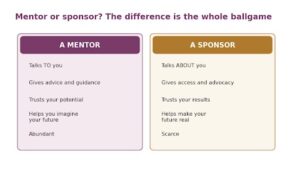
Advice is abundant. Advocacy is scarce. That is where careers stall.
Here is the uncomfortable truth behind a lot of stalled careers. Women are not short on advice. We are short on advocacy. Mentorship gives you guidance. Sponsorship gives you the room, the recommendation, and the stretch role that changes your trajectory. A mentor talks to you. A sponsor talks about you, in the meetings you are not invited to. The gap between those two things is where a great deal of talent quietly gets stuck.
The data is blunt. Research highlighted by Harvard Business Review found that women are 54 percent less likely than men to have a sponsor. The same body of work found that women who do have a sponsor are 27 percent more likely to ask for a raise and 22 percent more likely to seek the high-visibility assignments that build a reputation as a leader. Layer on the broken rung that McKinsey and LeanIn document in their Women in the Workplace research, where for every 100 men promoted from entry level to manager, only around 87 women are, and the picture is hard to miss. The shortfall is not talent. It is access.
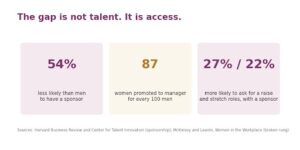
The numbers behind the access gap.
The real difference between a mentor and a sponsor
A mentor trusts your potential. A sponsor trusts your results enough to spend their own credibility on you. Mentorship may help you imagine your future. Sponsorship is what helps make it real. That distinction sounds small and it is not, because advice is abundant and advocacy is scarce. Most accomplished women have had several mentors. Far fewer have had someone with real power put their name forward when a decision was being made in a room they were not in. Both relationships rely on trust, but sponsorship asks for more of it, the kind earned through visible results, which is why it is rarer and why it matters more.
Why recognition feels like progress and is not advancement
This is the trap I watch capable women fall into, and it deserves to be named plainly. Being celebrated is not the same as being promoted. An award, a panel seat, a feature, these feel like momentum, and they have real value, but visibility on its own does not move a career. Visibility without action is vanity. Recognition becomes advancement only when someone converts it into an opportunity, a referral, a role, a deal. The question is not whether you are seen. It is whether being seen is producing anything that changes your position.
What a real community does that a single mentor cannot
One person can give you advice. A community can give you access. That is the reason a network like this exists, and it is why we built Club MamaBee around uplifting and recognizing women rather than simply gathering them. The point of the room is not the applause. It is that the woman beside you knows the hiring partner, has sat on the board, can make the introduction, and will say your name when a seat opens. Sponsorship does not have to come from a single senior executive who happens to take an interest. It can come from a community that decides, deliberately, to advocate for one another, which is especially powerful for women who lack easy access to the mostly senior, mostly male circles where sponsorship has traditionally lived.
What this looks like in practice
Picture a member who arrives with a strong record and a wall of recognition, and almost no advocacy. She has been on panels. She has won an award. Her career has still not moved in two years. Inside a community built for it, the shift is not another certificate. It is an introduction from a member who sits on the board of the kind of organization she has been trying to reach, made because that member has seen her work and is willing to vouch for it. That single act of advocacy does more than a year of mentoring did, because it puts her in the room where the decision happens. This example is illustrative, but it is the exact mechanism that turns recognition into advancement, and it is the mechanism a good community is designed to manufacture on purpose.
How to turn this into action this month
Look at your own circle and ask a harder question than usual. Not who advises you, but who advocates for you when you are not there. If the honest answer is no one, that is the gap to close, and you close it two ways at once. Get into rooms where advocacy actually happens, and start sponsoring other women yourself, because sponsorship tends to return to the people who give it. Recognition feels good. Advancement changes your life. Most women stay stuck on the first because no one ever told them they were different things.
Frequently asked questions
What is the difference between mentorship and sponsorship?
A mentor gives you advice and guidance. A sponsor actively advocates for you, recommending you for roles and opportunities and spending their own credibility to advance you. Mentors trust your potential. Sponsors trust your results.
Why do women receive less sponsorship than men?
Research shows women are significantly less likely than men to have a sponsor, largely because they have less access to the senior decision-makers who sponsor, and because organizations find mentorship programs easier to offer than genuine advocacy. The gap is about access to the rooms where advancement decisions are made.
How do I find a sponsor?
Deliver visible results, get into the rooms where senior people can see them, and build relationships of real trust rather than asking cold. Sponsorship is earned through performance and proximity, and a strong professional community can shorten the distance to both.
Can a networking community provide sponsorship?
Yes, when it is built for it. A community where members deliberately make introductions, advocate for each other, and open doors functions as distributed sponsorship, which is especially valuable for women who lack access to a single powerful sponsor.
Is recognition still worth pursuing?
Yes, as a means, not an end. Recognition builds the credibility that makes advocacy easier to give. It becomes valuable when someone converts it into a concrete opportunity, and it is wasted when it sits as applause that leads nowhere.
Sources
These references support the figures cited above. Confirm currency and link to the primary research before publishing.
Harvard Business Review / Center for Talent Innovation. Sponsorship and women’s advancement (54% sponsor gap; raise and stretch-assignment effects). https://www.fastcompany.com/3050430/why-women-need-career-sponsors-more-than-mentors
McKinsey & LeanIn. Women in the Workplace (the broken rung, ~87 women promoted per 100 men). https://www.mckinsey.com/featured-insights/diversity-and-inclusion/women-in-the-workplace
Gallup. Mentors and sponsors make the difference. https://www.gallup.com/workplace/473999/mentors-sponsors-difference.aspx
SHRM. Mentorship and sponsorship: core tools for talent growth. https://www.shrm.org/topics-tools/news/linkage/mentorship-sponsorship-core-tools-talent-growth