


You Built This Business the Right Way
You built your business from the ground up. You know your work inside out. You have proof it works. But somewhere between “I am good at what I do” and “I am consistently landing the right clients at the right price” sits a gap.
Most solopreneurs try to close that gap the wrong way. They follow the standard marketing playbook: post consistently, grow a following, chase impressions, run ads, build a list. These tactics are designed for high-volume, low-ticket businesses. If you are selling a high-ticket service to a small number of the right clients, they are fighting against you, not for you.
The Core Problem: Marketing Misalignment
Here is what we see inside Club MamaBee constantly: a consultant with six figures of revenue and zero marketing team. A fractional CMO who lands clients through a person she met once. A strategist whose best work finds her because someone she trusts sent it.
These are not lucky breaks. They are not working harder or posting more. They are running a different playbook. It is called relationship marketing, and it is how high-trust, high-ticket services scale.
The problem is that most marketing advice is not written for them. It is written for e-commerce brands, SaaS companies, and creators selling low-ticket digital products. If you have ever felt like the marketing world was designed for someone else’s business, you were right.
Understanding the Marketing Spectrum
All marketing activities exist on a spectrum. At one end is traffic marketing. At the other is relationship marketing. Where your business lives determines which approach will actually work.
Traffic Marketing: Built for Volume
Traffic marketing is built for volume. You cast a wide net, collect numbers, and bet that enough of the right people will find you. For low-ticket, high-volume products, this makes sense. You need a lot of buyers for the math to work.
Relationship Marketing: Built for Quality
Relationship marketing is built for quality. You do not try to reach everyone. You try to reach the right people, in the right rooms, with enough impact that they remember you. For high-ticket, high-trust services where a single client relationship is worth tens of thousands of dollars, this approach works wonders.
| Key Finding: Misalignment Costs Revenue
Clients with larger audiences often underperform compared to those with smaller, more focused followings. You need to be visible to the right few, not everyone. |
Why the Gap Gets More Expensive Every Year
Five years ago, you could run traffic marketing tactics for a relationship-based business and still win clients. The market had less noise. Buyers were less savvy.
That is not true anymore. Every year the cost of being in the wrong lane gets higher.
You post consistently, chase impressions, grow a following. Then you get on a sales call with someone who has never heard of you. That is the gap. That is where you lose the deal.
AI has accelerated this problem. Content is everywhere now. The market is louder than ever. High-ticket buyers are more skeptical. If you want to win, you cannot compete on volume. You have to win on trust.
The Three Stages of Relationship Marketing
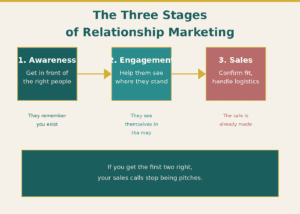
Relationship marketing works in three stages: awareness, engagement, and sales. Get all three right, and the sale stops being a pitch.
Stage 1: Awareness – Get in Front of the Right People
Most solopreneurs assume the right people will eventually find them. That assumption drives content calendars that produce impressions, not clients.
Flip that. Do not wait for people to find you. Go where they already are.
You can borrow an audience by guest teaching inside a membership, speaking at events, getting on podcasts, or joining peer groups. The rooms are everywhere once you start looking.
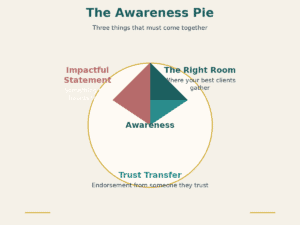
Showing up in a room is not enough. Three things must come together. The right room with the right people. A strong trust transfer from someone the audience already trusts. An impactful statement that people cannot stop thinking about after they leave.
Stage 2: Engagement – Help Them See Where They Stand
When someone discovers your work, they do not need more information. They need help making sense of their own problem. Use a diagnostic.
You take what someone learned and help them see where they stand. It can be an audit, self-assessment, or framework that lets them place themselves on a spectrum.
Here is what happens next. Something you said in awareness haunted them. They try to talk themselves out of it. Then they see the map and find themselves. Immediately, they feel relief. The most powerful words you can say are: “I have seen this before. Every client I work with starts in exactly this spot.”
Stage 3: Sales – The Sale Is Already Made
If you focus on awareness and engagement, a sales call stops being a sales call. There is no pitch. The person shows up already knowing what you do and believing you can solve their problem. The only question is fit and logistics.
| The Reference Call: Your Most Powerful Closing Tool
When a warm prospect hesitates, hand them to a long-term client. Someone they have no reason to distrust. That client tells them: “Yes, it is real. Yes, it works. Here is what happened for me.” The trust transfers. |
Relationship Marketing Compounds Over Time
Some relationships pay off in weeks. Others are slow burns that take months or years.
This is why relationship marketing does not look like marketing while it is happening. It looks like listening to a podcast. Showing up at the right event. Saying something in a room that sticks. The business outcome always shows up eventually.
The Small Infrastructure That Makes This Possible
Behind the scenes, relationship marketing requires a system. Not a complicated one. Just something that keeps you from letting important relationships go cold.
You could use a spreadsheet with names, last conversation, and next check-in date. What matters is the intention. Gratitude is not optional. A specific, personal gift says “we thought of you.” A branded mug says “we thought of our brand.” These land very differently.
This Is How You Scale Without Burnout
Most solopreneurs scale by working harder. More content. More outreach. Eventually you hit a wall. Relationship marketing scales differently. You are not trying to reach more people. You are trying to reach the right people with more impact. You do not need a sales team or an ads budget. You grow by showing up in the right rooms, saying things that stick, and staying in touch.
| Ready to Scale Through Relationships?
Bullzeye Global Growth Partners embeds alongside leadership teams to drive growth through hands-on execution and strategic partnerships. We work with solopreneurs and micro-agencies ready to scale without losing the relationships that got them here. http://mamabee.com/ |
From Club MamaBee
Uplifting and recognizing women building real businesses. One relationship at a time.